

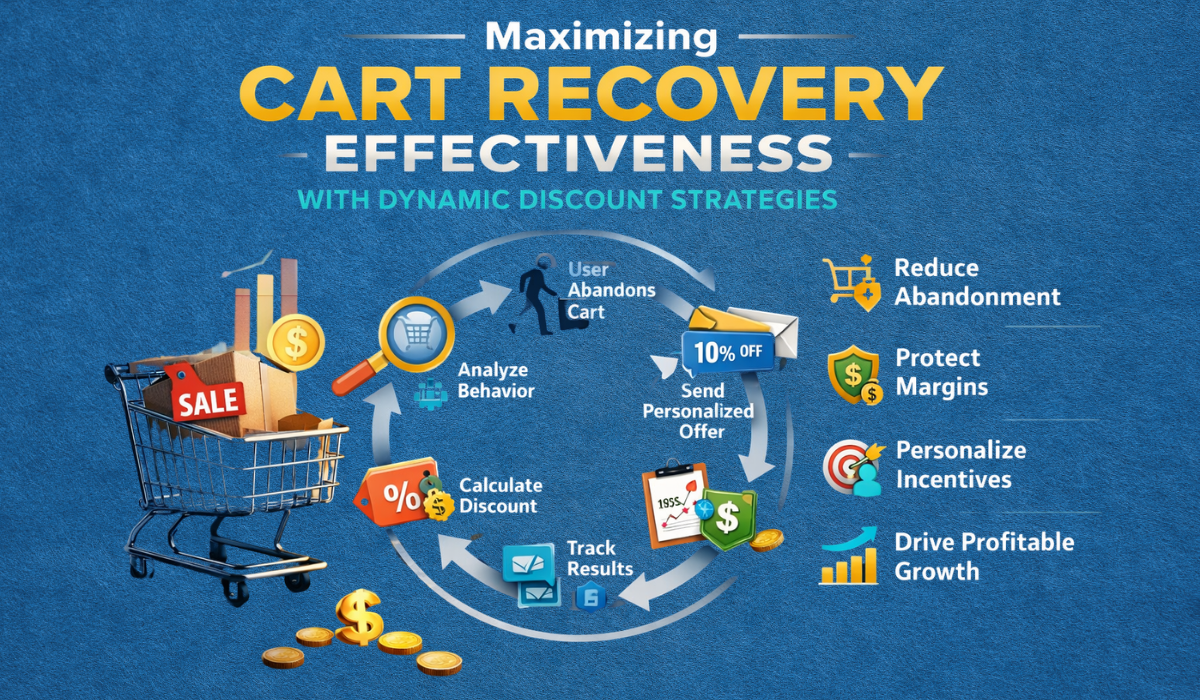
Introduction: The $18 Billion Revenue Leak
Every year, ecommerce brands lose an estimated $18 billion to cart abandonment . With average abandonment rates exceeding 70% across industries , the problem isn’t small—but neither is the opportunity.
Recovering even 10–15% of these lost sales can increase revenue by 15–25% without spending more on advertising . This is where dynamic discount strategies transform cart recovery from a blunt marketing tactic into a precision growth engine.
What Is Cart Recovery Effectiveness?
Cart recovery effectiveness measures how successfully a business re-engages users who abandoned their shopping carts and converts them into customers—profitably.
It differs from simple “recovery rate” by focusing on incremental lift: Did the discount cause the purchase, or would it have happened anyway?
Why Traditional Recovery Falls Short
Most brands still use static coupons—sending the same 10% off code to everyone. This approach:
- Trains users to wait for discounts
- Erodes margins on full-price buyers
- Ignores user differences (new vs. loyal, high vs. low cart value)
- Cannot optimize for profit
What Are Dynamic Discount Strategies?
Dynamic discount strategies use real-time or near-real-time data to determine if, when, and how much discount to offer an individual user.
Instead of fixed coupons, the system adapts based on:
- User behavior signals: Browsing history, exit intent, session duration
- Cart value and margin: High-margin items can support deeper discounts
- Purchase history: New users may need more incentive than repeat buyers
- Inventory levels: Overstocked items can be discounted more aggressively
- Predicted lifetime value: High CLV users justify better offers
How Dynamic Discounts Work: A Decision Flow
graph TD
    A[User Abandons Cart] --> B[System Waits 30-60 Minutes]
    B --> C{Check Eligibility Rules}
    C -->|Eligible| D[Calculate Discount Amount]
    C -->|Not Eligible| E[Send Reminder Only]
    D --> F[Select Delivery Channel]
    F --> G[Deliver Personalized Offer]
    G --> H[Track Conversion & Profit]
Why Dynamic Discount Strategies Matter for Cart Recovery
1. They Preserve Margins
Static coupons apply the same discount to everyone—including users who would have converted without any incentive. Dynamic systems use margin-aware logic to ensure discounts are only offered when profitable.
2. They Personalize the Incentive
A first-time visitor abandoning a $50 cart is different from a loyal customer abandoning a $500 cart. Dynamic strategies treat them differently, offering higher value to higher-value users while minimizing waste.
3. They Prevent User Conditioning
When users learn they always get a discount for abandoning, they start doing it intentionally . Dynamic systems introduce variability—sometimes offering discounts, sometimes not—which preserves full-price purchase intent.
4. They Scale with Machine Learning
Advanced systems use propensity models and uplift modeling to predict which users are most likely to respond and what discount amount maximizes profit, not just conversions .
Core Components of a Dynamic Discount System
For developers and growth teams, building an effective system requires several integrated components:
| Component | Purpose |
|---|---|
| Event Tracking Layer | Capture cart abandonment events accurately |
| Decision Engine | Apply rules or ML models to determine offers |
| Discount Service API | Generate and validate unique discount codes |
| Experimentation Framework | Run A/B tests to validate incrementality |
| Analytics Pipeline | Track revenue, profit, and user behavior |
| Channel Integrations | Deliver offers via email, SMS, push, etc. |
How to Design Eligibility Rules That Protect Profit
Not every abandoned cart deserves a discount. Eligibility rules act as a gatekeeper to preserve margins.
Recommended Eligibility Rules
- Minimum cart value: Exclude low-value carts where discounts erase profit
- Margin thresholds: Exclude low-margin products or categories
- User history: Limit frequency to prevent discount dependency
- Recent coupon usage: Exclude users who recently received offers
- Geographic rules: Adjust for regional price sensitivity
Example Rule Logic (Pseudo-code)
function isEligibleForDiscount(user, cart) {
  if (cart.totalValue < 50) return false;
  if (cart.averageMargin < 0.3) return false;
  if (user.discountsUsedLast30Days > 2) return false;
  if (user.isVip) return true; // VIPs always get offers
  return true;
}
Timing: When to Trigger Discount Offers
Timing directly impacts conversion rates. Too early, and you waste margin on users who might have returned naturally. Too late, and the user has moved on.
Optimal Timing Windows
| Timing | Use Case |
|---|---|
| 30–60 minutes | High-intent users who got distracted |
| 4–24 hours | Users comparing prices or犹豫 |
| 24–72 hours | Cold re-engagement with stronger incentives |
| Exit-intent (instant) | On-site popups for immediate capture |
Multi-Touch Sequences
Many successful programs use a sequence:
- Hour 1: Reminder only (no discount)
- Hour 24: Small incentive (5–10% or free shipping)
- Hour 48: Stronger incentive (10–15%) if cart value supports it
Delivery Channels: Where to Send Dynamic Discounts
Channel choice affects visibility, urgency, and conversion. Multi-channel recovery typically outperforms single-channel approaches.
Channel Comparison
| Channel | Open Rate | Conversion Rate | Best For |
|---|---|---|---|
| 20–40% | 2–5% | Detailed offers, branding | |
| SMS | 90–98% | 5–15% | Urgent, time-sensitive offers |
| Push Notifications | 10–20% | 1–3% | App users, quick reminders |
| On-site Popups | N/A | 3–10% | Exit-intent capture |
| Retargeting Ads | N/A | 1–2% | Broader reach, brand awareness |
Integration Tip
The decision engine should know which channels a user has opted into and prioritize accordingly. SMS may get a higher discount because it’s more intrusive and converts better.
How Machine Learning Improves Discount Decisions
As data volume grows, machine learning can optimize discount decisions beyond what rules can achieve.
Common ML Approaches
| Model Type | Purpose |
|---|---|
| Propensity-to-Buy | Predicts probability of conversion without discount |
| Uplift Modeling | Predicts incremental lift from offering a discount |
| Reinforcement Learning | Continuously optimizes discount amounts based on results |
| LTV Prediction | Estimates future value to justify higher acquisition costs |
When to Use ML
Start with rules-based systems. Move to ML when you have:
- At least 10,000 abandonment events per month
- Clean, consistent tracking data
- Engineering resources to maintain models
Measuring Cart Recovery Effectiveness: The Right Metrics
Effectiveness isn’t just about how many carts you recover—it’s about how profitably you recover them.
Key Performance Indicators
| Metric | Formula | Why It Matters |
|---|---|---|
| Recovery Rate | Recovered carts / Abandoned carts | Basic volume metric |
| Recovered Revenue | Total $ from recovered carts | Top-line impact |
| Average Discount Depth | Avg discount % offered | Tracks incentive cost |
| Profit per Recovered Cart | (Revenue – COGS – Discount) / Carts | True profitability |
| Incremental Lift | (Variant conversion – Control conversion) / Control | Measures true impact |
| Repeat Purchase Rate | % of recovered users who buy again | Long-term value |
The Control Group Imperative
Without a randomized control group that receives no discount, you cannot measure incrementality. Many users would have returned anyway. A 5% control group is industry standard.
A/B Testing Framework for Dynamic Discounts
Testing validates whether your discounts are working—or just wasting money.
What to Test
| Variable | Test Ideas |
|---|---|
| Discount amount | 5% vs. 10% vs. 15% |
| Discount type | Percentage vs. free shipping vs. fixed $ off |
| Timing | 1 hour vs. 24 hours vs. 48 hours |
| Channel | Email only vs. SMS only vs. both |
| Eligibility rules | Broad vs. strict margin filters |
Testing Structure
- Control group: No discount
- Variant A: 10% off
- Variant B: Free shipping
- Sample size: Run to statistical significance (usually 2–4 weeks)
Common Mistakes That Reduce Effectiveness
Even well-intentioned programs fail when these pitfalls appear.
Top 7 Mistakes to Avoid
- Discounting too aggressively: Wastes margin and trains users to wait
- No frequency capping: Creates discount dependency
- Ignoring margin data: Discounts on low-margin items destroy profit
- No experimentation: Assumptions replace data
- Blanket offers to everyone: Wastes money on users who would convert anyway
- Poor timing: Too early or too late kills response
- No abuse prevention: Users exploit loopholes
How to Prevent Discount Abuse
Discount abuse can quickly erode margins. Secure your system from day one.
Technical Safeguards
- Single-use tokens: Codes expire after one use
- User-bound coupons: Tied to specific email or account
- Expiration timestamps: Short windows prevent sharing
- Server-side validation: Never trust client-side checks
- Rate limiting: Prevent brute-force attempts
- IP tracking: Flag suspicious activity
Privacy and Ethical Considerations
Dynamic discounting relies on user data, which brings responsibility.
Compliance Checklist
- GDPR / CCPA compliance: Honor opt-outs and deletion requests
- Consent-based tracking: Only track users who consent
- Data minimization: Collect only what you need
- Transparency: Clearly explain how discounts are personalized
- Unsubscribe options: Make opting out easy
FAQ: Answers to Common Questions
Do discounts always improve cart recovery?
No. Discounts only improve recovery when they generate incremental profit. Many users would convert without incentives. Always test against a control group.
How much discount should I offer?
Start between 5–15% and optimize based on margins and test results. Higher-value carts and users may justify deeper discounts.
Can dynamic discounts hurt brand perception?
Yes, if overused. Constant discounting makes products seem overpriced. Use variability and frequency caps to protect brand equity.
Is free shipping better than percentage discounts?
Often yes. Free shipping removes a specific friction point and may cost less than a percentage discount, especially on lower-priced items.
How long should a recovery campaign run?
Most recoveries happen within 24–72 hours. After that, impact drops significantly. Consider longer windows only for high-value items.
Should every abandoned cart receive an offer?
No. Target users with high predicted uplift. Blanket discounting wastes margin and trains users to abandon intentionally.
How do I measure incremental lift correctly?
Use randomized control groups and compare profit per user, not just conversion rates. Control groups should receive no discount.
Are AI-driven discounts worth it for small stores?
Start with rules-based logic. AI becomes valuable when you have sufficient data (10,000+ abandonment events monthly).
What’s the biggest technical risk?
Checkout failures or latency caused by discount logic. Recovery systems must never break core purchase flows. Build with fallbacks.
Conclusion: Profit-First Recovery
Dynamic discount strategies transform cart recovery from a blunt marketing expense into a precision profit engine. By combining real-time data, margin-aware logic, and rigorous experimentation, ecommerce teams can recover lost revenue without destroying profitability or training users to wait for deals.