

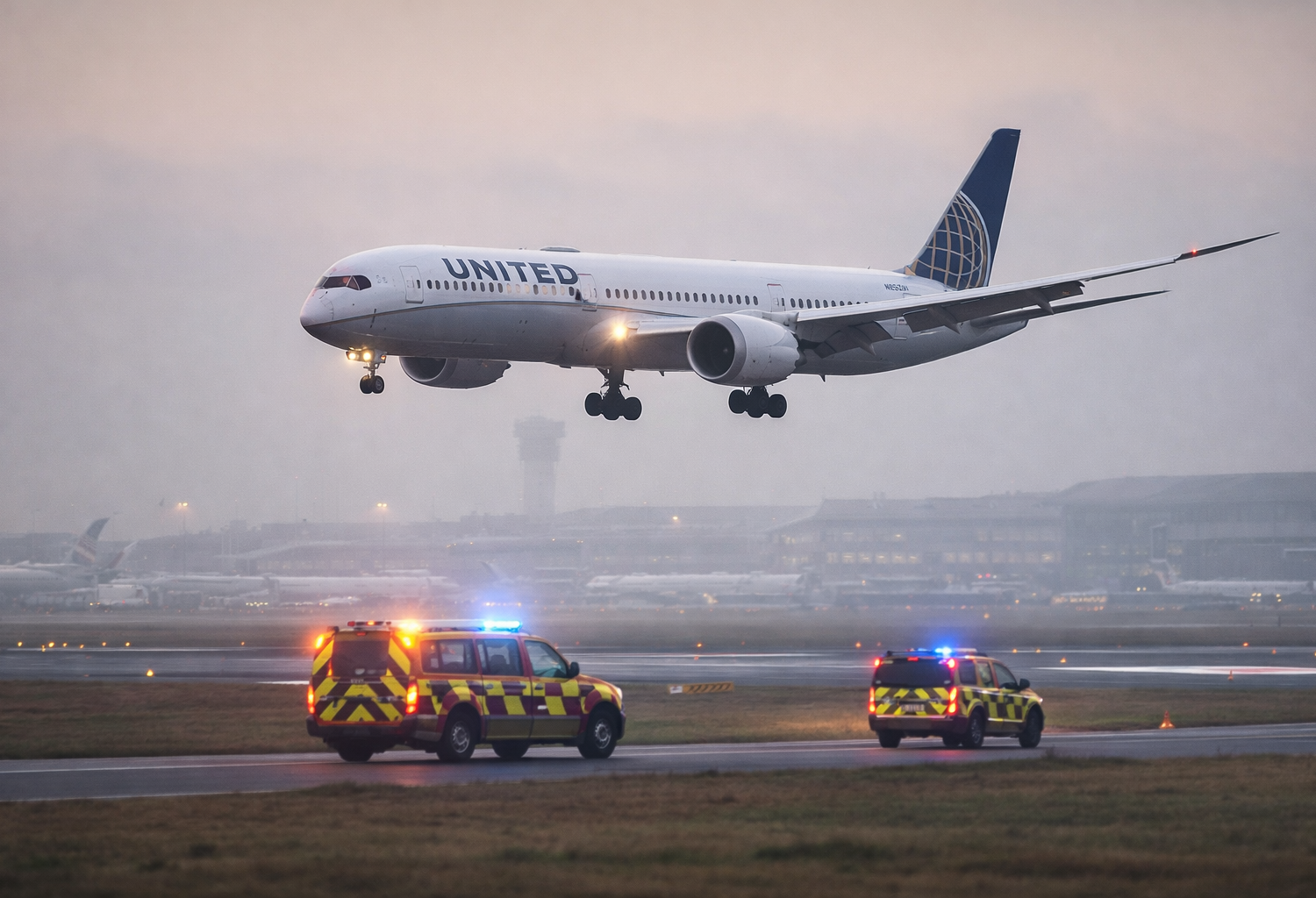
On May 27, 2025, United Airlines Flight UA770, a Boeing 787-9 from Barcelona to Chicago, made a precautionary emergency diversion to London Heathrow due to a cabin pressurization alert. All 257 passengers and 12 crew members landed safely, with emergency vehicles on standby but not needed. The crew’s calm professionalism reassured passengers, and United Airlines provided meal vouchers, hotel accommodations, and rebooking assistance. The aircraft, tail number N26902, underwent a full technical inspection. The incident highlights aviation’s robust safety systems, showing that emergency diversions are precautionary measures handled with precision and care.
The Incident: A Routine Flight Takes a Different Path
United Airlines Flight UA770 was a standard long-haul rotation operated by a Boeing 787-9 Dreamliner, a state-of-the-art aircraft known for its composite structure and advanced systems. On board were 257 passengers and 12 crew members, all settling in for the journey across the Atlantic .
Approximately 90 minutes into the flight, as the aircraft cruised comfortably at 37,000 feet, the flight deck received an alert indicating irregular readings from the cabin pressurization system . This system is critical; it maintains a safe and breathable atmosphere at high altitudes where the outside air is thin. While the situation had not escalated to a dangerous loss of pressure—oxygen masks were not deployed—the pilots treated the warning with the utmost seriousness.
In a matter of moments, the crew activated the universal aviation emergency transponder code, Squawk 7700. This digital distress signal alerts air traffic control (ATC) that the aircraft is facing a general emergency, granting it immediate priority handling and a clear path in the skies . The decision was made to divert the flight to London Heathrow, a strategic choice given its world-class emergency services, long runways suitable for heavy wide-body aircraft, and comprehensive maintenance facilities.
The aircraft descended smoothly and landed safely at Heathrow’s Runway 27R at approximately 4:55 PM BST. Emergency vehicles were on standby as a precaution, but their services were not required. All passengers and crew disembarked safely with no reported injuries .
Inside the Cabin: A Passenger’s Perspective
For those on board, the experience was a mix of sudden tension and professional reassurance. A passenger recounting the experience noted the shift in atmosphere when the captain calmly announced the diversion . The phrase “declared an emergency” can be alarming, but the composure of the flight attendants was key.
“We started checking seatbelts, and the crew gave instructions as they walked through the aisle,” one passenger recalled. “Their attitude under pressure was much more comforting than if they had spoken.” This effective communication helped maintain order in the cabin. As the plane descended toward London, the landing was smooth, prompting a collective sigh of relief and even some applause from fellow travelers. This first-hand account underscores that while the event was unexpected, the human element—the training and demeanor of the crew—was instrumental in keeping the situation calm and controlled .
The Anatomy of a Safety Decision: Why Diversions Happen
When searches for “United Airlines Flight UA770 emergency diversion today” spike, it’s often because people are seeking confirmation and understanding of the event. It is crucial to distinguish between a crisis and a precautionary measure. An emergency diversion is a preemptive safety protocol, not an admission of failure. In this case, the pressurization alert, even as a potential sensor ambiguity, triggered a protocol that prioritizes caution over schedule.
The choice of London Heathrow was deliberate. While closer airports existed, Heathrow’s infrastructure offered the best combination of factors:
- Advanced emergency support teams and medical services.
- Maintenance capabilities specifically for the Boeing 787-9 Dreamliner.
- Passenger handling resources for rebooking and accommodations.
This decision-making process, coordinated with EUROCONTROL and national ATCs across Europe, highlights the sophisticated network that activates during an in-flight anomaly .
The Aftermath: Passenger Support and Aircraft Inspection
Upon landing, United Airlines activated its customer care protocols. Passengers were met by ground staff who provided meal vouchers, arranged hotel accommodations for those with significant delays, and rebooked travelers on alternative flights to Chicago . This response is a critical part of the “diversion” narrative; it demonstrates an airline’s commitment to mitigating the inconvenience caused by a necessary safety decision.
Meanwhile, the aircraft itself, identified by its tail number N26902, was grounded for a thorough technical inspection. Preliminary findings pointed to a malfunction within the pressurization system, which would be fully investigated by the airline in coordination with regulatory bodies like the FAA and EASA .
Broader Implications: A Testament to Aviation Safety
The successful handling of the UA770 incident is a powerful case study in why air travel remains the safest form of long-distance transportation. It illustrates the layered safety systems that work in concert: advanced real-time aircraft health monitoring that detects anomalies early, rigorous pilot training that ensures correct protocol execution, seamless ATC coordination that clears a safe path, and airport preparedness that receives the aircraft .
While passengers might search for “emergency diversion seat” to understand their role during such events, the reality is that following crew instructions is the primary duty. The professionalism displayed by the crew of UA770 kept passengers informed and secure in their seats, transforming a potentially frightening scenario into a manageable one.
Conclusion
The United Airlines Flight UA770 emergency diversion was not a story of danger, but one of diligence. From the moment the pressurization alert sounded over the Atlantic to the safe touchdown at Heathrow, every action taken was a testament to the aviation industry’s unwavering commitment to safety. It serves as a reassuring reminder that when the unexpected occurs, the systems, technology, and trained professionals in place are designed to ensure that everyone arrives on the ground safely, even if it’s not at the planned gate.
Frequently Asked Questions
1. Was anyone on board United Flight UA770 injured during the emergency diversion?
No, there were no injuries to any passengers or crew members. The diversion was a precautionary measure taken to address a technical alert, and the landing was executed safely .
2. What exactly caused the United Airlines Flight UA770 emergency diversion?
The cause was a technical anomaly detected in the aircraft’s cabin pressurization system. The pilots observed irregular readings from the system and, following strict safety protocols, decided to divert the flight to the nearest suitable airport as a precaution .
3. Why did Flight UA770 divert to London instead of returning to Barcelona or going to a closer airport in France?
London Heathrow was chosen because it is one of the world’s best-equipped airports to handle a large aircraft like the Boeing 787-9 Dreamliner. It has long runways, immediate access to advanced emergency services, and maintenance facilities specifically for that aircraft type, making it the safest option at the time of the incident .
4. How long were passengers delayed, and what did United Airlines do for them?
The length of the delay varied for each passenger based on their final destination and the availability of new flights. Upon landing, United Airlines provided immediate support, including meal vouchers, hotel accommodations for those with extended layovers, and rebooking assistance to get passengers to Chicago .
5. What does “Squawk 7700” mean in the context of this flight?
“Squawk 7700” is a universal transponder code used in aviation to indicate a general emergency. When the crew of Flight UA770 set this code, it immediately alerted air traffic control that the aircraft required priority handling and a clear path to land, allowing for a swift and coordinated response .
6. Is it safe to fly after an incident like this?
Yes, absolutely. In fact, incidents like this reinforce how safe air travel is. The successful diversion demonstrates that safety protocols work exactly as designed. The multiple layers of protection—from aircraft sensors to pilot training and ground coordination—ensured that a minor technical issue was managed effectively without escalating into a dangerous situation .